
History of Surya Namaskar: The Surprising Origins of Sun Salutations

Becca is the author of Teaching Yoga: Creative Cueing for Safer Mixed Level Classes. A long-time studio owner and teacher trainer, she now teaches in OKC and creates resources for other yoga teachers.
When I first discovered yoga, I loved practicing Surya Namaskar, commonly known in English as Sun Salutations. Numerous teachers, including some famous ones, said that the sequence was ancient and was performed by monks in caves thousands of years ago.
It wasn’t until years later, while reading history books, that I discovered this was a yoga myth. I still love practicing Surya Namaskar, but I now know that the sequence was not part of early yoga systems and was fused with yoga asana in the 1930s by the famous teacher Tirumalai Krishnamacharya. If this information is new to you, then no worries, the sequence is still very special and healing in many ways. In this post, I’ll review the history of Surya Namaskar, how the sequence became incorporated into modern yoga practice, and provide some references for further study.
So where did Surya Namaskar actually come from?
Although there is some debate among scholars, it is likely that Surya Namaskar originated in the 1600s as a warm-up for wrestling and weightlifting. [1] Around this time, a number of classical yoga texts were written, and Sun Salutations were not mentioned in any of them.
It is likely that the development of Sun Salutations was influenced by the sun-worship ritual practiced in temples, but although the standing-to-prone transition is familiar, many of the other movements are quite different. [2] Scholars agree that the Surya Namaskar sequence was popular in weight-lifting and wrestling gyms in India in the 1800s. [3]
In 1924, Bhavanarao Pant Pratinidhi published an exercise book titled Surya Namaskar for Health, which widely popularized the sequence. Later in 1938, he published a new book titled The Ten-Point Way to Health: Surya Namaskars. His second book became the leading guide for Sun Salutations at the time. In the early 1930s, both yoga asana classes and Surya Namaskar classes were taught at the palace in Mysore as two separate practices.

For more yoga teaching ideas, check out my book on Amazon!
How Did Surya Namaskar Become Part of Modern Yoga?
After Krishnamacharya began teaching at the palace in Mysore in 1933, he integrated Surya Namaskar with yoga asana, creating a single flowing practice. He is considered the creator and father of modern yoga practice.
During this time, exercise routines of all types were developed worldwide. Magazines covering “physical culture” became prevalent with photos of toned bodies practicing various exercises. Visitors to the palace in Mysore came from all over the world to perform gymnastics, dance, weightlifting, and wrestling. Krishnamacharya designed a modern practice influenced by popular physical culture. [4]
Pattabhi Jois, one of Krishnamacharya’s students, took his teacher’s ideas and created and popularized Ashtanga Yoga, a faster-paced, flowing practice with specific sequences. Students of Jois continued creating various forms and vinyasa-style yoga. As different teachers adapted the sequence, multiple versions began to emerge. Now, some variation of Surya Namaskar appears in most modern yoga classes, even if it’s quite modified.
Why Understanding the History of Surya Namaskar Matters
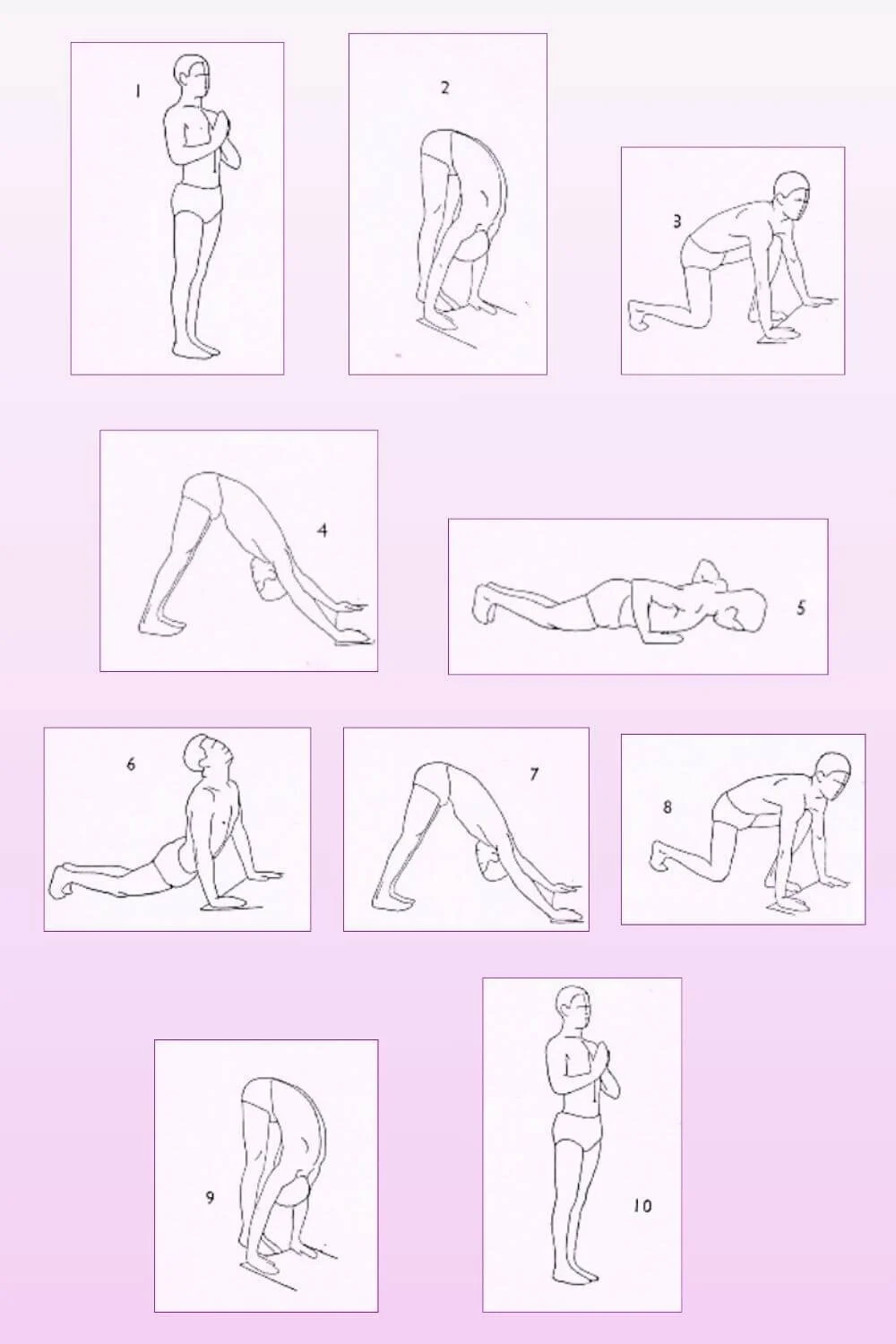
From the 1938 book, “The Ten-Point Way to Health” by Pratinidhi
The most important takeaway for yoga teachers from this discussion is the understanding that modern yoga is an evolving practice. Yoga changes to best serve every generation. We do not need to hold onto the idea that there is some perfect ancient tradition that must be followed in the absolute. As yoga teachers, this understanding frees us to create thoughtful sequencing and modifications that work for our students.
Krishnamacharya was creative and focused on his students’ mental and physical health. I firmly believe that if he had witnessed what modern phones and computers have done to our bodies, he would have changed the sequences to better serve them. Krishnamacharya helped his students create their own yoga practice. [5] He encouraged his students who became teachers to innovate, and so, in turn, it's up to us as modern teachers to continue the work.
What is the best version of Surya Namaskar?
The number of Sun Salutation variations can be overwhelming for serious new yoga students. Some teachers make a name for themselves by claiming their version is the best or the original. The version you can do that works for you and your students is the correct one. We have different options because people need and want different things from their yoga.
Because the exact origins of Sun Salutations are a little unclear, there is no historical record of an “original” sequence. [6] The closest we have to this is A and B, which Pattabhi Jois popularized with Ashtanga yoga. These sequences involve jumping or stepping backward from Halfway lift to Four-Limb Staff pose (Chaturanga), and then later jumping or stepping forward from Downward Dog.
Jumping back and forth between these positions is a challenge that may even be harder than the modern burpee (have you noticed the similarities?) Many Ashtanga practitioners offer the option of walking the feet backward and forward rather than jumping. Teachers in other styles of yoga continued to vary and modify this basic sequence, including poses such as low lunge, revolved lunge, revolved chair, cobra, locust, high plank, side plank, and standing side stretch.
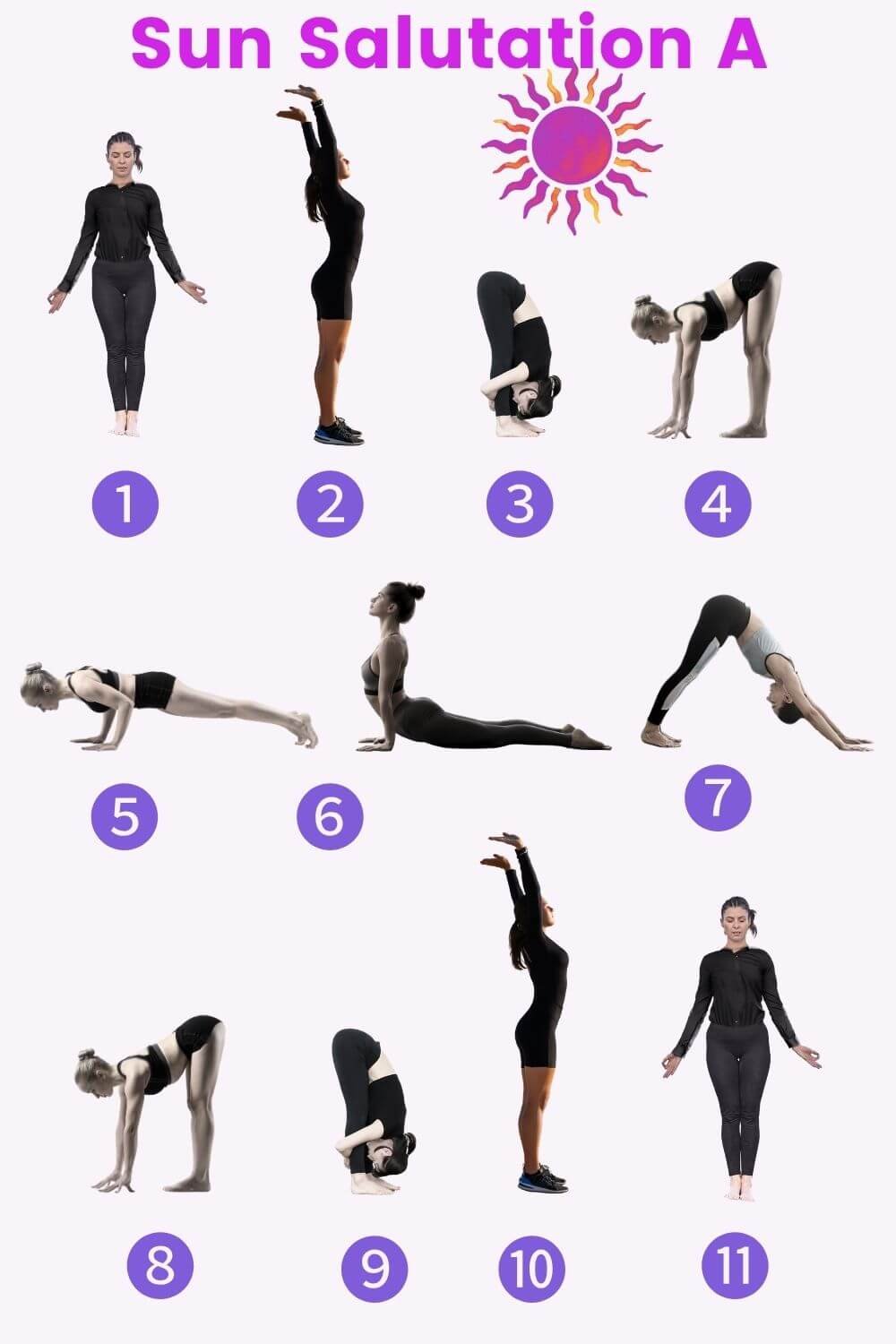
Surya Namaskar A and B Poses
There is much more detail about the history of Surya Namaskar, so my post here is just an overview. Check out the references I listed below if you love history and want to dive deeper. If you are new to yoga and need help learning Sun Salutation A and B, then see my listing of the poses below.
Keep learning, keep teaching, and trust that your voice matters. The more you share your unique way of teaching, the more lives you’ll touch. Feel free to reach out if you need support for your teaching. ♢
Sun Salutation A
1. Mountain
2. Upward Salute (Extended Mountain - arms overhead)
3. Standing Forward Bend
4. Standing Half Forward Bend (Spinal Extension)
*jump or step back
5. Four Limbs Staff (Chaturanga Dandasana)
6. Up Dog
7. Down Dog
*jump or step forward
8. Standing Half Forward Bend (Spinal Extension)
9. Standing Forward Fold
10. Extended Mountain (arms overhead)
11. Mountain
Sun Salutation B
1. Mountain
2. Chair
3. Standing Forward Fold
4. Standing Half Forward Bend (Spinal Extension)
*Jump or step backward
5. Four Limbs Staff (Chaturanga Dandasana)
6. Up Dog
7. Down Dog
8. Warrior 1 Right Foot forward
9. Four Limbs Staff (Chaturanga Dandasana)
10. Up Dog
11. Down Dog
12. Warrior 1 Left foot forward
13. Four Limbs Staff (Chaturanga Dandasana)
14. Up Dog
15. Down Dog
*Jump or step forward
16. Standing Half Forward Bend (Spinal Extension)
17. Standing Forward Fold
18. Chair
19. Mountain
Footnotes
[1] Goldberg, p. 187
[2] Goldbery, p. 186
[3] Singleton, p. 124
[4] Singleton, p.114
[5] Desikachar, p. XIX
[6] Goldberg, p. 187
References
Desikachar, T.K.V. The Heart of Yoga: Developing a Personal Practice. Inner Traditions International, 1995.
Goldberg, Elliott. The Path of Modern Yoga. Inner Traditions, 2016.
Singleton, Mark. Yoga Body: The Origins of Modern Posture Practice. Oxford University Press, 2010.
Pratinidhi, B.P. The Ten-Point Way to Health: Surya Namaskars. J.M. Dent and Sons LTD, 1938.
Pin Me!
➪ For more teaching yoga tips, check out my book on Amazon
➪ To receive 6 hours of free CEUs, join my video course:
FREE Mixed Level Teaching Essentials Course!
➪ Check out my video library! Over 400 videos with accessible classes, including modifications.
